Start here
Our thesis
AI, models and inference
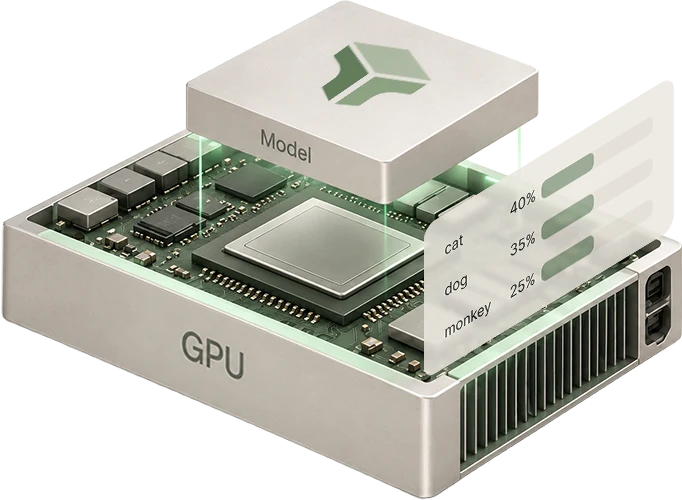
Most people know AI through apps and assistants. Behind each of them is a model, a large set of numbers learned from data, such as Llama or Qwen. Models run on GPUs, chips designed to perform many calculations at the same time, which is why GPUs have become central to AI.
A model is built through training, in which it learns from large amounts of data. It does not understand words and has no feelings. It only knows which words tend to follow which. After “the apple is”, red and green are likely, while white hardly ever is. Producing text this way is called inference. The model writes one word at a time, and each word requires a full pass through the model on a GPU to find what fits best next.
Training is a large but one-off cost. Inference is paid for every time a model is used, so its cost grows with every request. Google processed 9.7 trillion tokens a month in 2024, 480 trillion a month in 2025 and 3.2 quadrillion a month in 2026, where a token is a small piece of text such as a word [1].
Tokens processed by Google, per month
- 20249.7 trillion
- 2025480 trillion
- 20263.2 quadrillion
As a token is about three quarters of an English word, that is roughly 2.4 quadrillion words a month, enough to fill more than 25 billion novels [2].
The real problem
Trust
AI is used for increasingly important work, from assessing loans and handling insurance claims to agents that move money. Every answer comes from running a model, and the model behind it determines the outcome. With providers offering a range of models at very different prices and with different capabilities, it is important that buyers get the model they paid for.
The problem is that a provider can sell one model and quietly run another, cheaper one, which may produce a different decision than the promised model, and no one would know. A model picks each word partly by chance, so any difference can be put down to luck.
QuestionWhat pet should I get?
Provider A
Qwen3-8B
A dog.
The model paid forProvider B
Qwen3-8B
A cat.
A cheaper modelUnfortunately, this already happens. The same open model is sold by many providers, and in November 2025 Moonshot AI reported that some third-party endpoints that claim to be serving Kimi K2 Thinking scored more than 20 percentage points lower on accuracy than Moonshot's own Kimi K2 Thinking [3]. The model name was the same, but the results were not, and the buyer had no way to tell.
A second problem
Waste
The core principles of Bitcoin are a scarce coin, a ledger outside the control of any central institution, and proof of work to secure it. But on Bitcoin, that work is a search for a number with no use outside of securing the chain. It consumes about 138 TWh of electricity a year, roughly 0.5% of global electricity [4], and all of it goes to securing the chain and nothing else.
Bitcoin
- Work
- Guessing numbers
- Output
- Nothing else
TensorCash
- Work
- Answering questions
- Output
- Answers with proof
TensorCash takes the best of Bitcoin and fixes the problem. On TensorCash, proof of inference functions as proof of work. Elsewhere, a GPU either mines or serves customers with inference, but on TensorCash, serving the customer is also mining. The same inference produces a verifiable answer for the customer and the proof of work for the chain.
One computation for both
To secure the chain, every new block has to cost real effort. On most proof of work chains, that effort is hashing. It ensures that mining costs power, so that rewriting the chain would mean redoing all of that work, but it has no use beyond this [5]. On TensorCash, inference is this proof of work. Inference providers, the miners on TensorCash, run models that answer real questions, and the same computation competes for the block reward.
Elsewhere
On TensorCash
To make the model verifiable, its word choices are tied to a public number from the latest block, so the work cannot be done in advance, and every choice is recorded. Anyone can rerun the promised model on that record and see whether it makes the same choices [6][7].
What this means
Verified inference
A buyer no longer has to take the provider's word for it. Every answer can carry a proof of which model produced it, which the buyer or an independent verifier can check [7].
This matters most where answers have consequences, such as a loan decision or a patient file, or where regulation demands it.
Companies now have proof that their data was processed by the model they paid for, and for a bank or an insurer, that proof functions as the audit trail.
Cheaper inference
A decentralised network can produce inference more efficiently than a centralised provider, because much of its hardware already serves another purpose. Selling inference fills the hours it would otherwise sit idle, while a centralised provider has to build and pay for all of its capacity.
On top of that, an inference provider on TensorCash has two sources of income for the same work. Customers pay for the answer, and the same inference can earn block rewards [6]. The block reward covers part of the cost of hardware and electricity, so the provider needs less revenue from each answer to break even. The computation and electricity behind an answer stay the same, but the provider can offer it at a lower price, which makes inference more abundant and more available.
1Two kinds of hardware
Datacenter built to sell inference
Hardware that already serves another purpose
- Idle hours, still paid for
- Its own work
- Idle hours sold as inference
2Two incomes for the same work
- Covered by the block reward
- Paid by the customer
3A lower cost per answer
More abundant, more available inference
A stronger network
Verified, more abundant inference attracts customers. Customers give providers a reason to supply compute. More compute makes the network harder to attack and able to serve more.
References
- [1]Google, I/O 2026: Welcome to the agentic Gemini era, Sundar Pichai, 19 May 2026.blog.google/innovation-and-ai/sundar-pichai-io-2026/
- [2]OpenAI, Understanding and counting tokens.help.openai.com/en/articles/4936856-what-are-tokens-and-how-to-count-them
- [3]Kimi (Moonshot AI) on X, 10 November 2025.x.com/Kimi_Moonshot/status/1987892275092025635
- [4]Cambridge Centre for Alternative Finance, via Cambridge Judge Business School, 28 April 2025.www.jbs.cam.ac.uk/2025/cambridge-study-sustainable-energy-rising-in-bitcoin-mining/
- [5]Satoshi Nakamoto, Bitcoin: A Peer-to-Peer Electronic Cash System, 2008.bitcoin.org/bitcoin.pdf
- [6]TensorCash whitepaper, Proof-of-Inference and Proof-of-Work.tensorcash.org/whitepapers/TensorCash_Whitepaper-modern.pdf
- [7]Inference Verification: Mathematical Specification.tensorcash.org/whitepapers/Verification_Whitepaper-modern.pdf
- [8]EU Artificial Intelligence Act, Article 12: Record-keeping.artificialintelligenceact.eu/article/12/