Temaer · Ecosystem
The reply that mines the chain: inside TensorCash's third-party ecosystem
Protocols call themselves ecosystems long before they have one. The test is simpler: do people you have never met build things you did not commission, put them in front of real users and skip the permission slip?
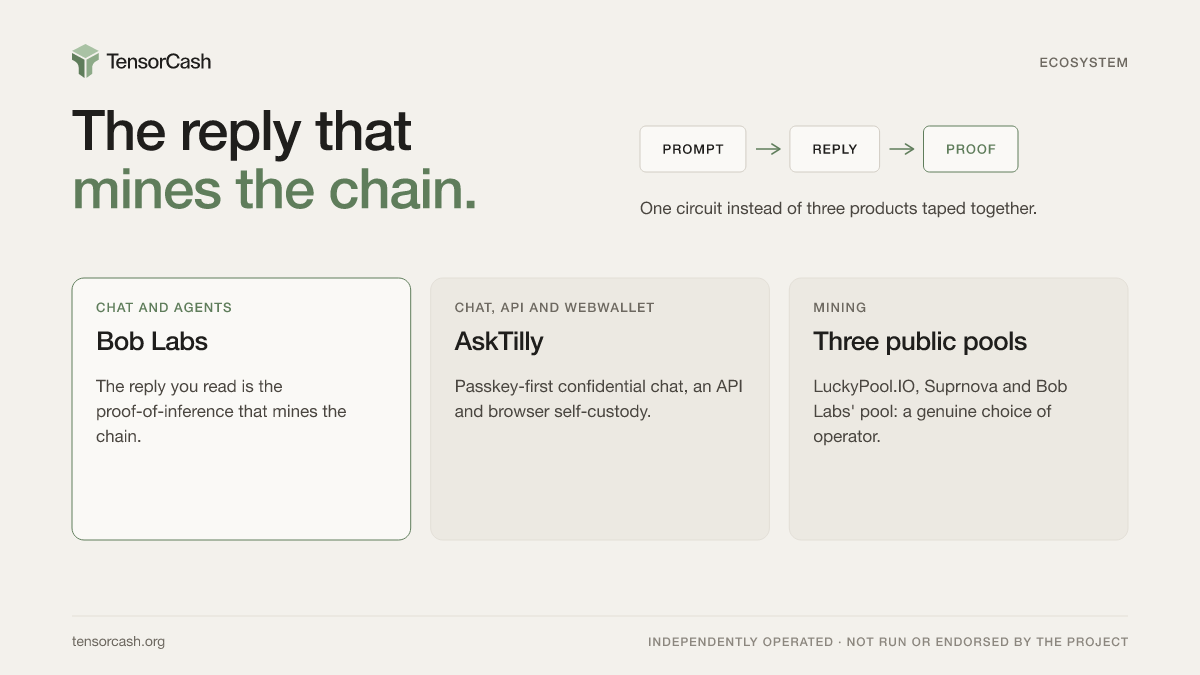
That is beginning to happen on TensorCash. One product puts a full chat and agent-orchestration platform inside a mining pool, so answering a prompt and mining the chain become the same job. Another brings passkey-first confidential chat, an API and browser self-custody. Around them, three public pools are giving miners a genuine choice of operator.
A note before the tour: every service below is independently operated. The project does not run, endorse or verify them — that is rather the point.
Bob Labs: when the answer is the work
Bob Labs runs a TensorCash mining pool — and, on top of it, chat.tensorcash.boblabs.eu. The line at the top of the chat says it plainly: the reply you read is the proof-of-inference that mines the chain. Here, that is not a metaphor.
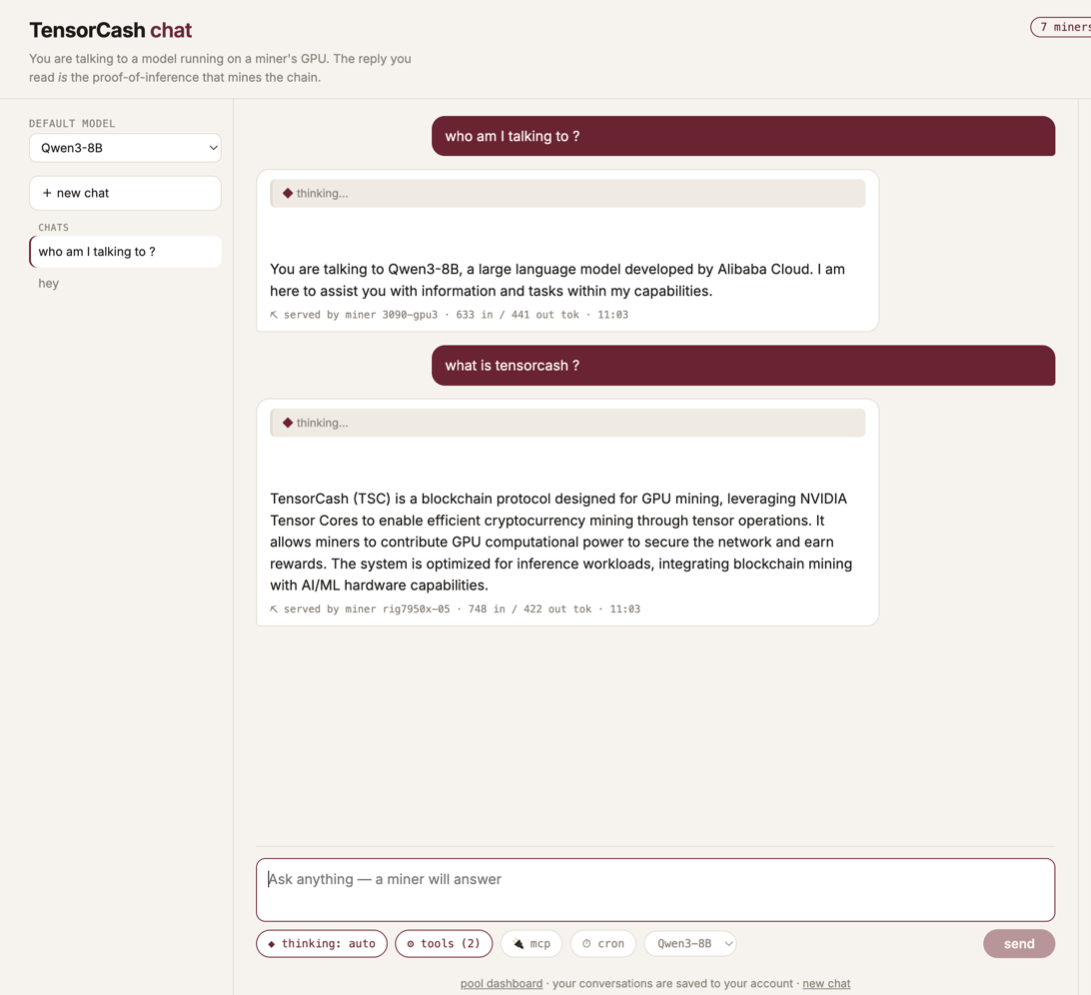 The Bob Labs TensorCash chat: a conversation with Qwen3-8B where each reply is annotated "served by miner 3090-gpu3 · 633 in / 441 out tok". The composer offers thinking mode, tools, MCP and cron controls.
When you ask a question, the prompt is dispatched to a GPU belonging to one of the pool's miners. The answer streams back to you; the inference that produced it is packaged as a proof and submitted to the network as mining work. Each reply names the miner that served it and shows the exact input and output token counts.
Not every answer discovers a block, of course. Every answer is nevertheless mining work, rather than useful computation performed beside an unrelated puzzle. Prompt, reply, proof: one circuit instead of three products taped together.
That trick would be enough to carry a demo. Bob Labs has built the rest of the product too:
- Agents — custom personas with their own instructions, models and tools;
- Labs — multi-agent orchestration with scheduled task execution;
- Tools and MCP — opt-in web search and page reading, plus MCP connectors for external sources such as Wikipedia, arXiv and maps;
- Memory — persistent context you can view, edit or delete;
- Cron jobs — prompts that run themselves on a schedule;
- API keys — programmatic access, with usage prepaid in TSC.
The economics complete the circuit. Pricing is denominated in TSC (1 TSC per million output tokens at launch), sign-up asks for no card and no identity, and new accounts get 50,000 free inference credits. You can arrive pseudonymously, pay in the network's own coin and send demand directly towards the miners doing the work. The pool publishes its stats at tensorcash.boblabs.eu.
AskTilly: enterprise-grade chat, API and a self-custody webwallet
If Bob Labs begins with the miner, AskTilly begins with the user. One of TensorCash's earliest independent adopters, it also runs a verification service for the community.
AskTilly is an enterprise-grade chat and agent platform built passkey-first, with end-to-end confidentiality: conversations are encrypted so that infrastructure operators cannot read them, and sign-in uses a passkey rather than a password. The same platform is available through an API for teams building their own agents.
The newest piece is the WebWallet — TensorCash self-custody in a browser:
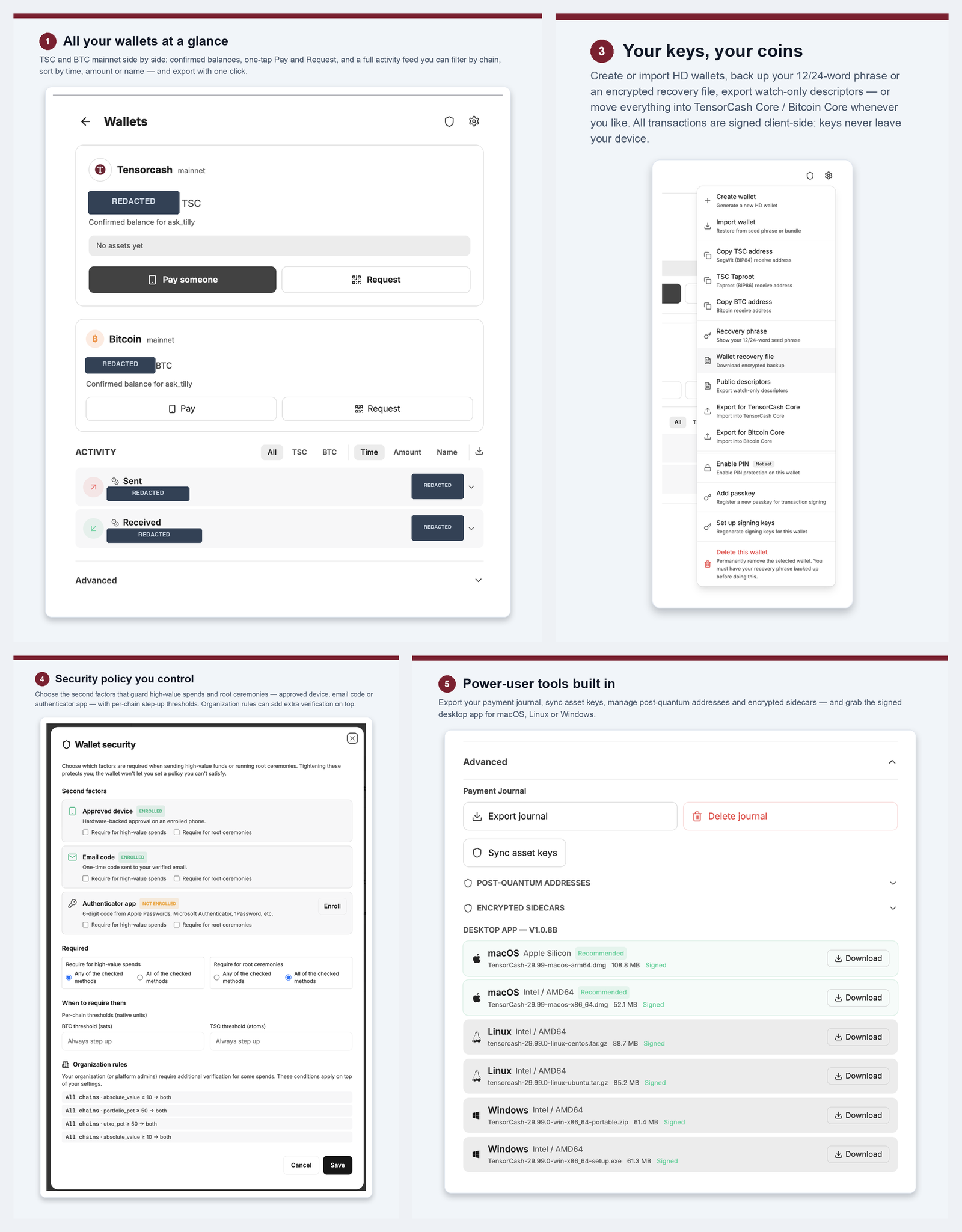 Four views of the AskTilly WebWallet: TSC and BTC wallets side by side with activity feed; the wallet menu with recovery phrase, watch-only descriptors and Core export; the wallet-security policy dialog with second factors and per-chain step-up thresholds; and the advanced panel with payment-journal export, post-quantum addresses, encrypted sidecars and signed desktop downloads.
- You custody your assets. All transactions are signed client-side; keys never leave your device.
- Passkey-unlocked signing. A compatible passkey authenticator uses the WebAuthn PRF extension to unlock the client-side signer.
- SegWit, Taproot and post-quantum addresses, saved contacts, an exportable payment journal and encrypted sidecars — plus signed desktop builds for macOS, Linux and Windows for those who prefer to run everything locally.
One product starts at the miner and follows the inference outward. The other starts at the user and brings authentication, confidentiality and custody inward. Both meet on the same chain.
Three public pools
Applications are the visible half of the ecosystem. Pools keep the underlying market for mining work open, and TensorCash now has three public pools, each run by an independent operator.
LuckyPool.IO runs a PPLNS TensorCash pool with both pool and solo modes. At the time of writing it hosts 81 miners across 289 workers — a healthy slice of the network's ~17 KPoI/s.
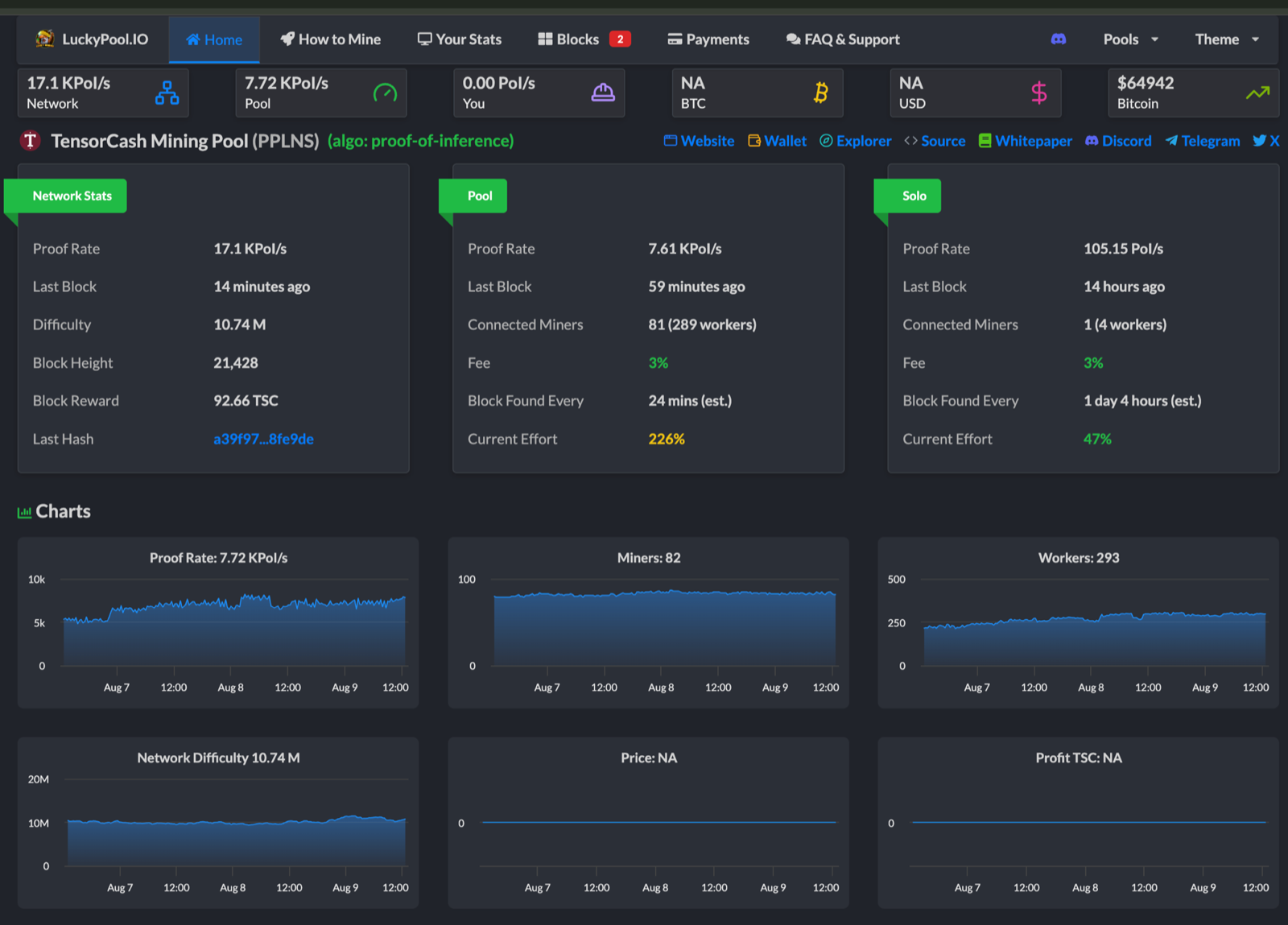 The LuckyPool.IO TensorCash dashboard: network, pool and solo statistics with proof-rate, miner and worker charts, at block height 21,428.
tsc.suprnova.cc brings TensorCash to Suprnova, a name long-time altcoin miners will recognise without an introduction. Its arrival matters for the least glamorous and most important reason: choice.
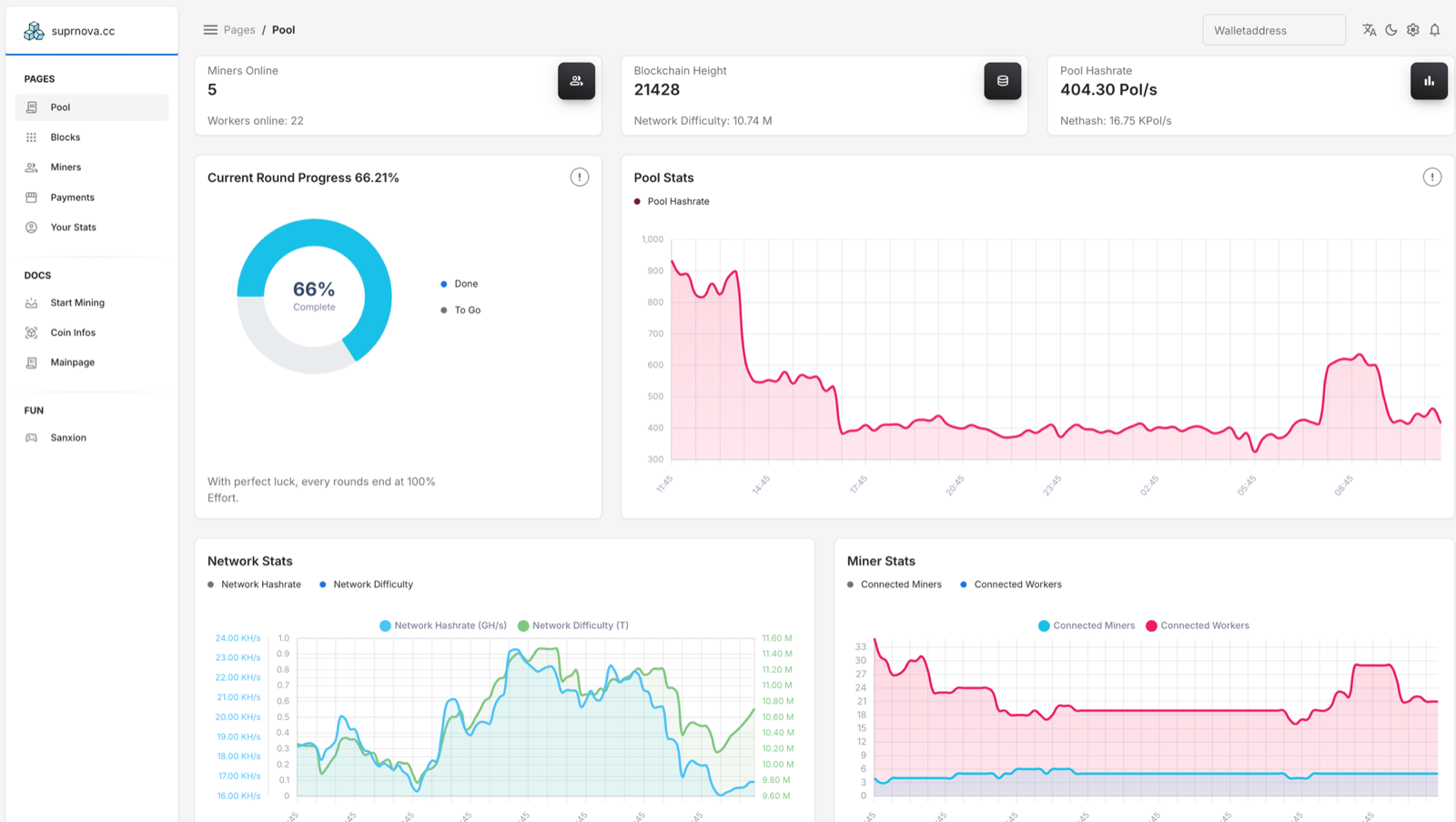 The Suprnova TensorCash pool: round progress, pool proof-rate, network and miner statistics.
Bob Labs' pool rounds out the trio — the same pool that serves the chat above, which means its miners earn from blocks found on work that includes real users' conversations.
Three pools do not, by themselves, guarantee decentralisation; distribution still matters. They do give miners something essential: a choice of operators, fees, payout models and dashboards.
Build the next one
None of this required a private integration deal. Independent teams built on public interfaces and a public network. If you are running a service, a pool, a build or a tool on TensorCash, add it to the community directory — it takes one pull request.
The circuit closes. The ecosystem stays open. Build the next piece.
The services above are independently operated; the project does not operate, endorse or verify them. Do your own diligence before trusting any service with funds or keys.