Onderwerpen · Explainer
Real-World Assets on TensorCash: the ticker is the easy part
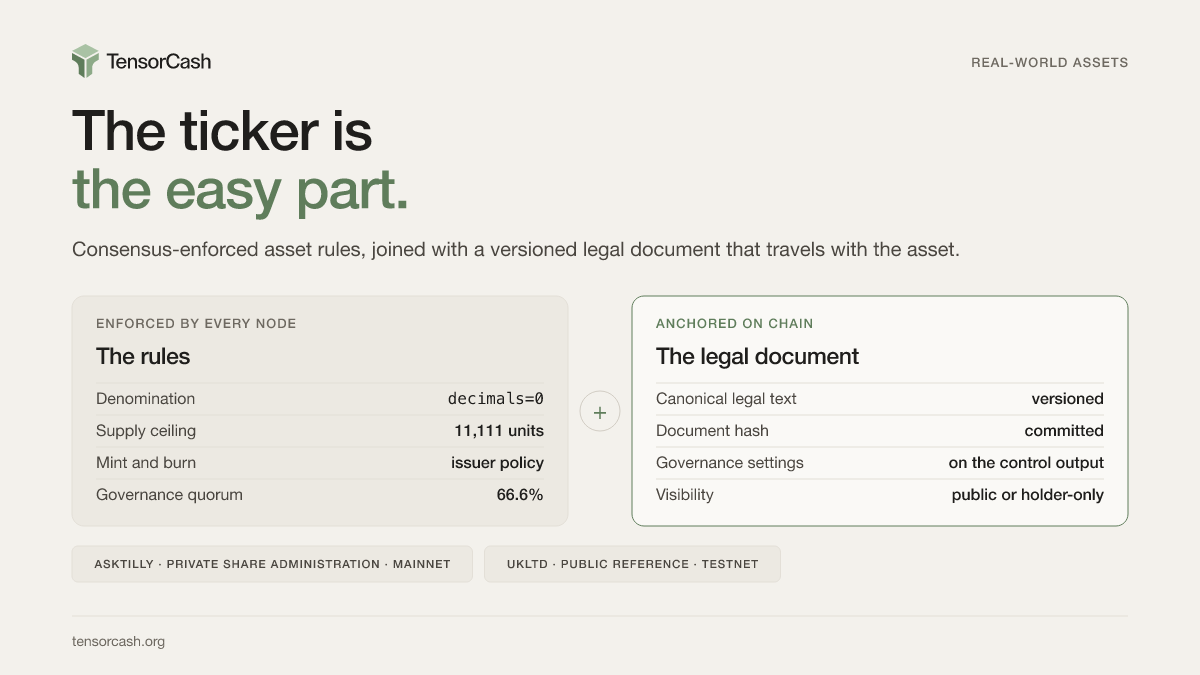
Real-world assets are one of the clearest places where crypto meets mainstream finance. But what is an RWA — and what separates a real one from a database entry with good branding?
A blockchain can move a digital unit pseudonymously, efficiently and across borders, around the clock. What it cannot do by itself is tell you what that unit means. A ticker is a label, not a legal relationship.
If a unit represents cash, reserves, a portfolio of securities or a share in a company, somebody must define the claim, sign the terms and explain what happens when things go wrong. Real assets also have a life after issuance: they pay distributions, change in size, vote, recover from lost keys and sometimes amend their rules.
The chain is necessary. It is not sufficient.
TensorCash joins the two halves: consensus-enforced asset rules and a versioned legal document that travels with the asset. Here is the model, illustrated by ASKTILLY, a real private-company share administration asset on mainnet, and UKLTD, a public educational reference on testnet.
1. Start with the rules the network can enforce
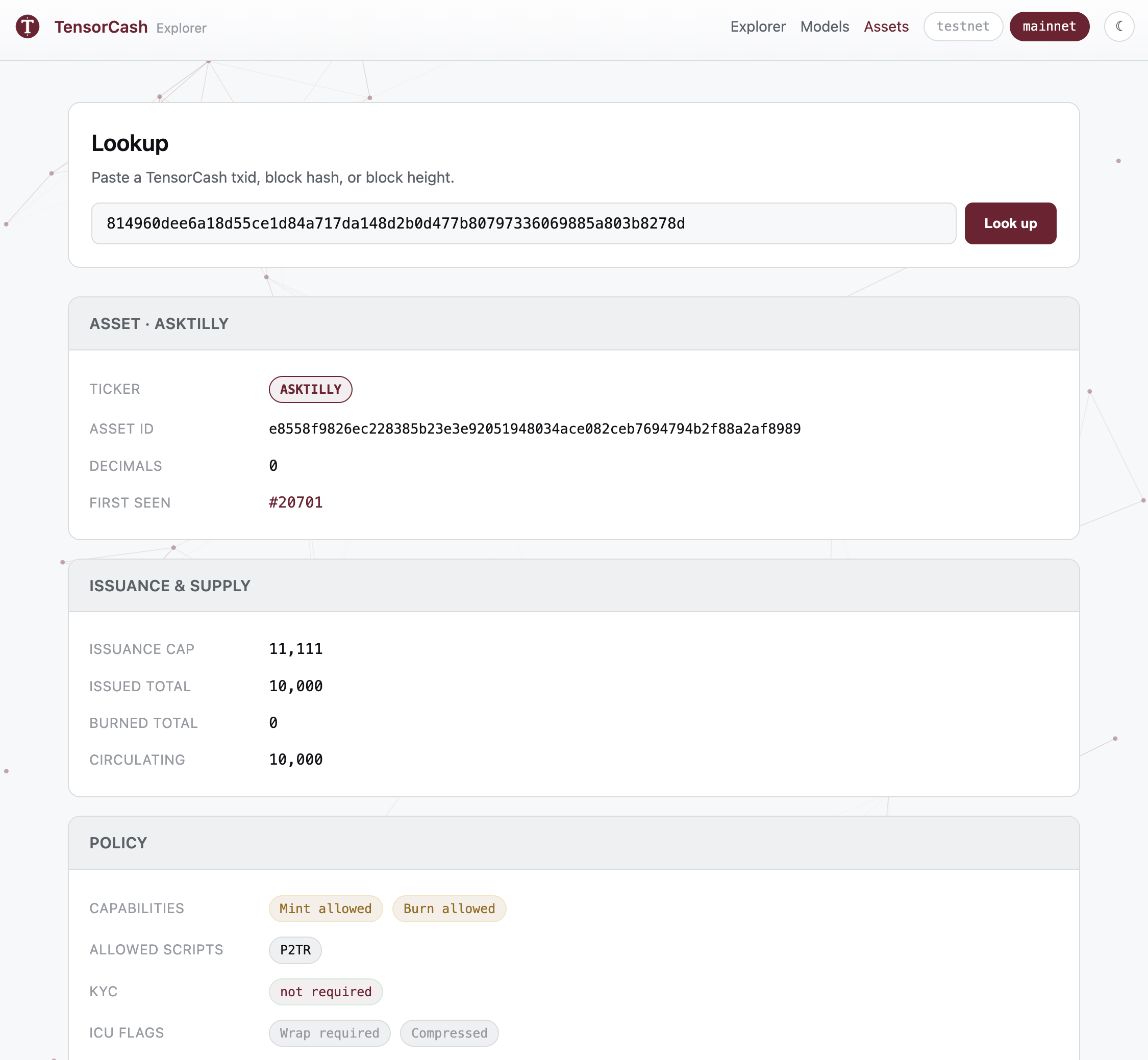 TensorCash explorer page for the ASKTILLY asset on mainnet: ticker ASKTILLY, decimals 0, issuance cap 11,111, issued total 10,000, circulating 10,000, with policy capabilities "Mint allowed" and "Burn allowed", allowed scripts P2TR, and KYC not required.
Every TensorCash asset is registered with parameters that nodes can verify:
- Denomination.
decimals=0means one unit cannot be split. For ASKTILLY, one live unit represents one whole share; cash-like assets can use finer denominations. - Supply ceiling. ASKTILLY has a hard live-supply cap of 11,111 units. Its initial 10,000 units represent 10,000 existing registered shares. A valid burn frees equal headroom for a replacement unit, but live supply can never exceed the cap.
- Mint and burn policy. An issuer can permit controlled minting and burning, or choose a fixed, non-burnable design. The network enforces the registered choice.
- Holding and governance rules. ASKTILLY is Taproot-only, keeps investor KYC and recognition obligations off-chain, stores its document holder-encrypted and commits to a 66.6% governance quorum.
Code is good at stopping unit 11,112. It is less good at deciding who inherits a share or what remedy applies after a breach. That is where the document matters.
2. Put the terms beside the ticker
Each asset has an on-chain control output that anchors its canonical legal text, document hash and governance settings. The text can be public or holder-only.
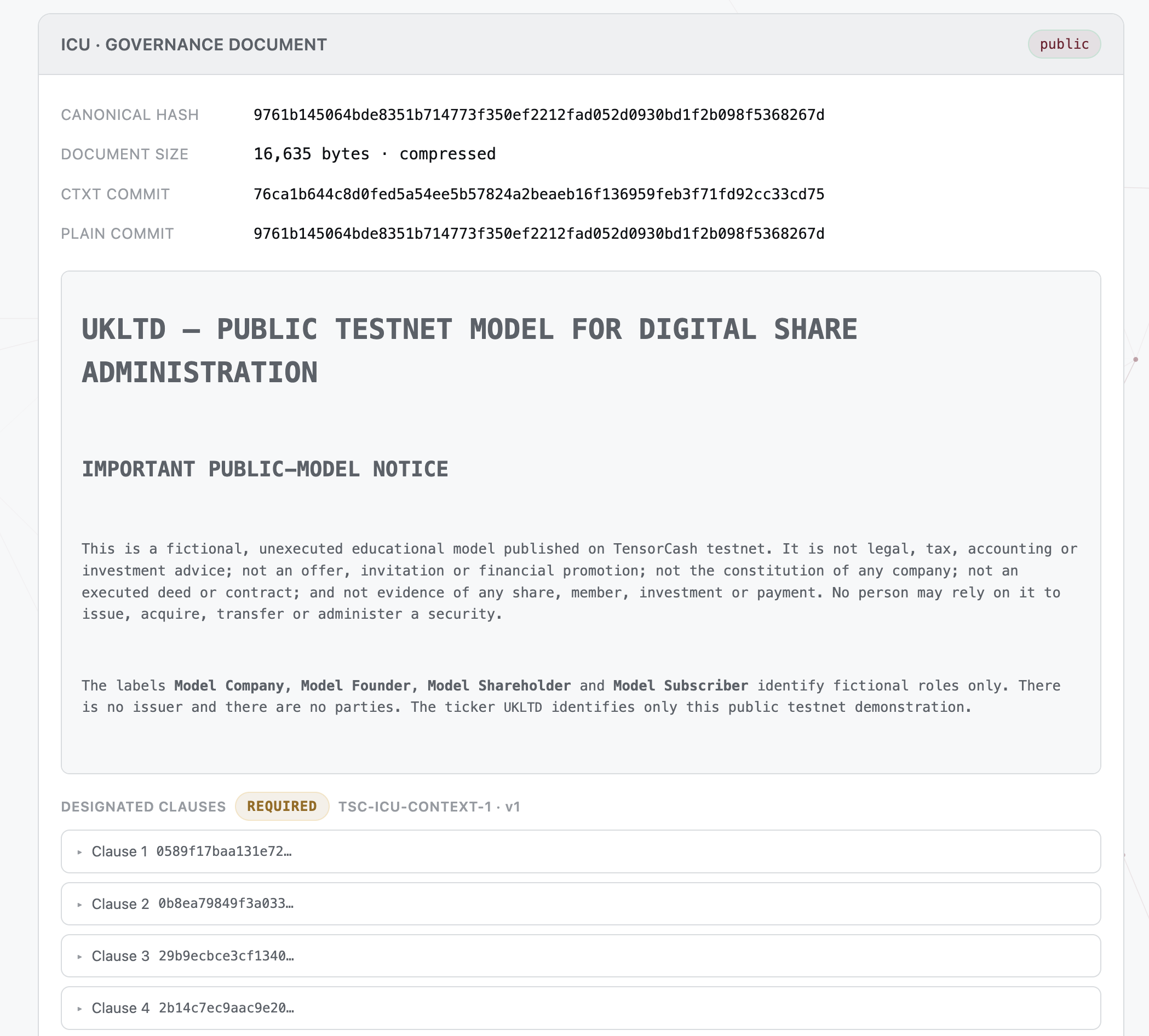 TensorCash testnet explorer showing the UKLTD public governance document: canonical hash, document size, commitments, the full "UKLTD — public testnet model for digital share administration" text with its public-model notice, and the required designated clauses.
Public text is readable by everyone. This suits instruments whose terms are intended for broad disclosure, such as a public fund or reserve-backed product. UKLTD is our worked testnet example: a fictional, unexecuted model containing illustrative articles, a shareholders' agreement, an investment agreement and digital-administration terms. It is educational material — not a company, security or offer.
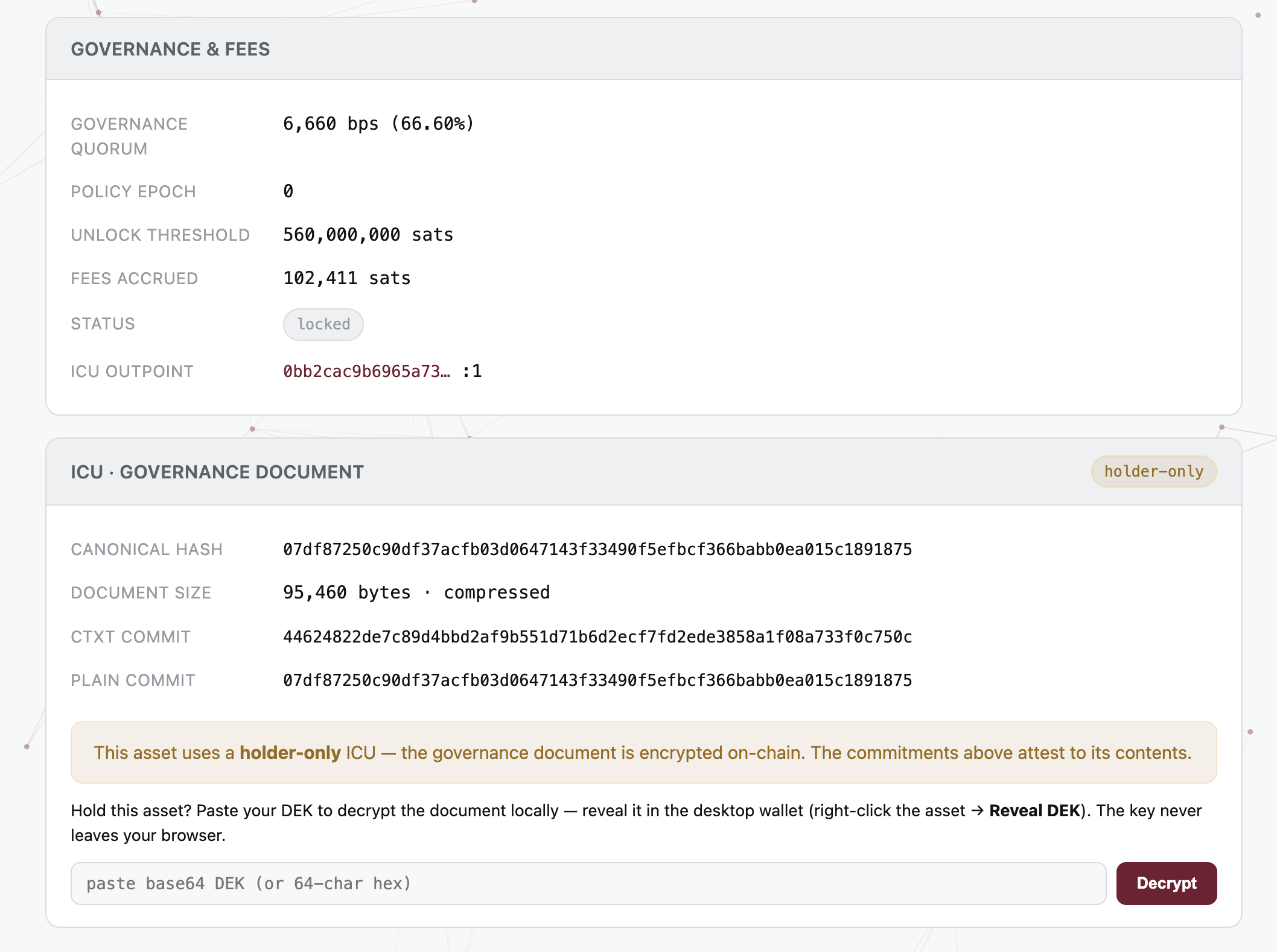 TensorCash mainnet explorer showing the ASKTILLY holder-only governance document: governance quorum 66.60%, canonical hash and ciphertext/plaintext commitments, a note that the document is encrypted on-chain, and a field where a holder can paste their key to decrypt it locally in the browser.
Holder-only text is encrypted on-chain. The document commitment remains public, while authorised holder wallets can decrypt the text and verify locally that it is byte-for-byte identical to the committed version. ASKTILLY uses this mode: its complete canonical pack is about 320 KB before compression and is stored as roughly 95 KB of encrypted on-chain payload.
Privacy does not require trust. Public readers can verify the commitment; holders can verify both the commitment and the words.
Text and witness: one document, clean evidence
The canonical text and its witness bundle have different jobs. The text contains the terms. The witness contains signatures, certificates and attestations proving who approved those exact bytes.
That separation allows an issuer to use a qualified electronic-signature ceremony, a DocuSign-style workflow or another attestation provider without rewriting the document to insert signatures. Signers sign its hash; the witness ties their evidence back to it. Important or onerous clauses also receive individual commitments so wallets can present them explicitly rather than hiding them on page 97.
An approved investor can review the whole document and the highlighted clauses,
then sign a 0x40 acceptance record in the wallet. That record binds the holder,
position, quantity and exact document version. In an operative issuance such as
ASKTILLY, it can provide contractual accession; in the fictional UKLTD model, it
is deliberately only a technical demonstration.
3. Run the asset after launch
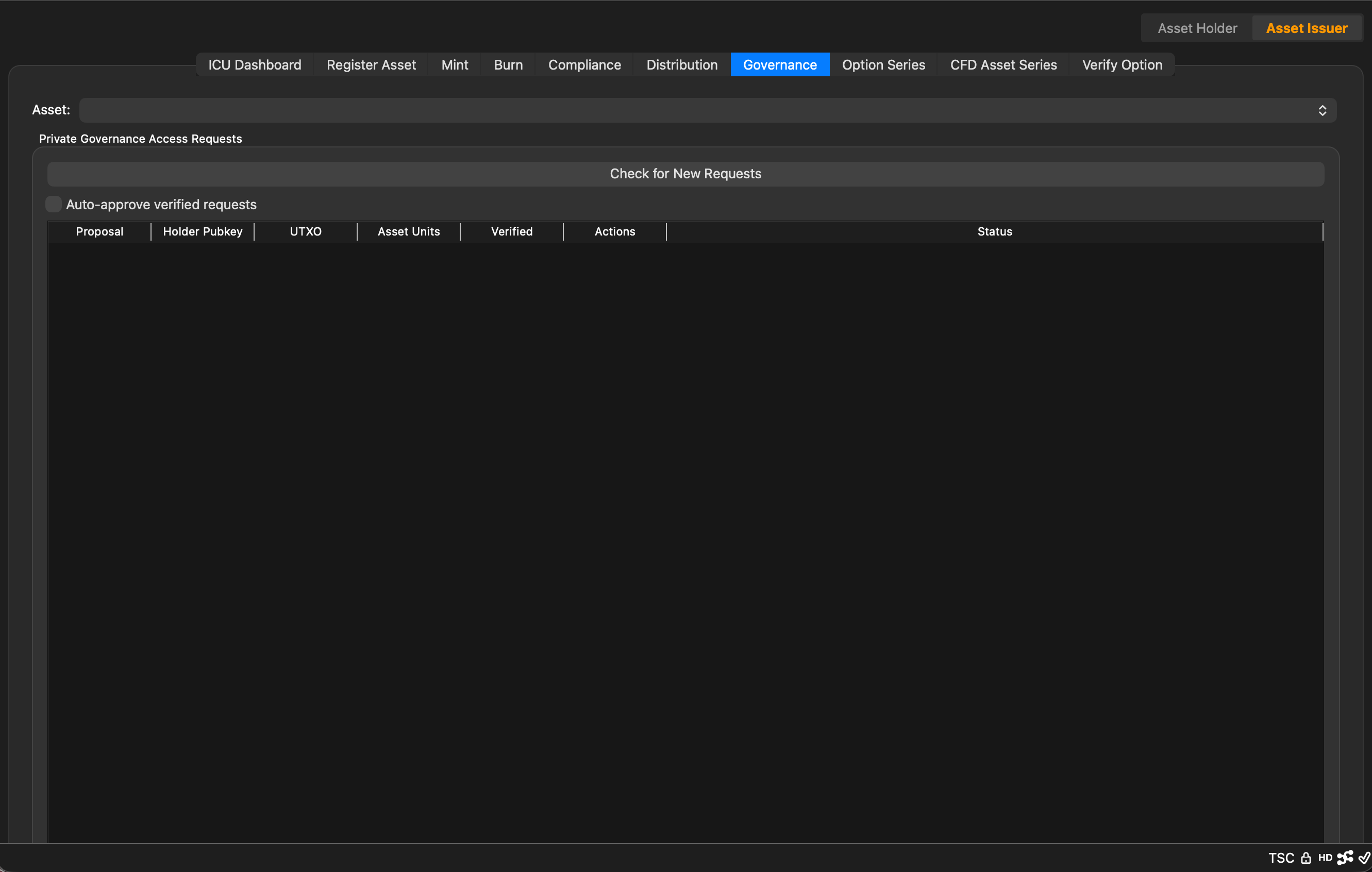 The issuer console in TensorCash Core: an Asset Issuer mode with tabs for ICU Dashboard, Register Asset, Mint, Burn, Compliance, Distribution, Governance, Option Series, CFD Asset Series and Verify Option, showing the private governance access request queue.
Registration is day one, not the finish line. TensorCash Core's issuer tools cover the asset's working life:
- register, mint and burn within the committed policy;
- administer compliance and holder access to private documents;
- make dividends, coupons or other distributions;
- put governed changes to a holder vote; and
- create and verify option or CFD asset series referencing the underlying asset.
The CFD tooling is a useful example of first-class treatment: a registered asset can become the reference for a cash-settled derivative without moving the underlying units. The feature supplies protocol plumbing; the issuer still has to satisfy the applicable legal, regulatory and commercial requirements.
The ticker is still the easy part
A credible RWA needs three things to agree: the unit the network moves, the rules consensus enforces and the rights the law recognises. Leave out any one and the structure is incomplete.
TensorCash makes all three first-class. Assets can be issued and administered natively; holders can inspect and accept their terms; and the resulting instruments can support distributions, financing, exchange and derivatives where their governing documents and applicable law permit.
The clever part is not putting a ticker on-chain. It is giving the ticker something real to mean.
Explore ASKTILLY on the mainnet explorer and UKLTD on testnet. UKLTD is fictional educational material. Nothing in this post is legal, tax or investment advice, or an offer of any instrument.