Proof of Inference
One GPU, two jobs
Every proof of work chain asks its miners to show that they spent real computation. Every new block has to cost real effort, so that rewriting the chain would mean redoing all of that work. On Bitcoin, that computation is hashing. Specialised machines run the same function over and over until one result falls below the target set by the difficulty. The result secures the chain and, until now, served no other purpose [1].
As a result, a GPU either secures a network or serves customers. Time spent on one is time lost for the other, and the miner has to choose between them.
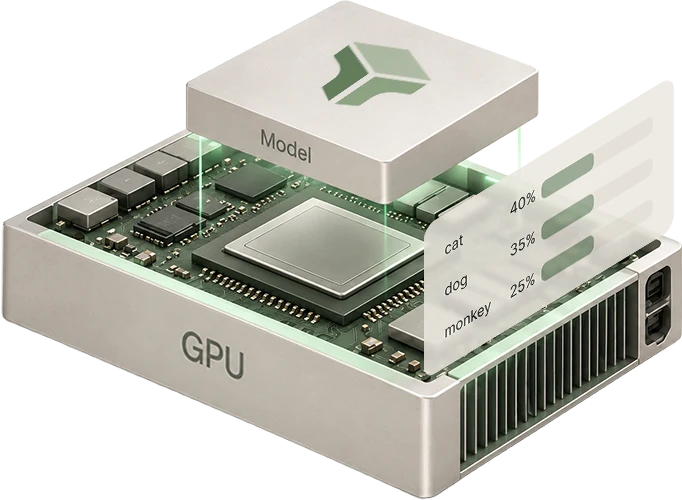
TensorCash removes that choice, because proof of inference functions as proof of work. What changes is the computation itself. The model runs as it normally would to answer a question, and the only difference is where its randomness comes from. Instead of a private random generator, the model draws from a number derived from the chain [2][3]. That single change lets one run produce two things at once.
Elsewhere
On TensorCash
One run
For the customer, an answer with a proof of which model produced it.
For the chain, a candidate for the next block.
References
- [1]Satoshi Nakamoto, Bitcoin: A Peer-to-Peer Electronic Cash System, 2008.bitcoin.org/bitcoin.pdf
- [2]TensorCash whitepaper, Proof-of-Inference and Proof-of-Work.tensorcash.org/whitepapers/TensorCash_Whitepaper-modern.pdf
- [3]Inference Verification: Mathematical Specification, The Sampling Contract.tensorcash.org/whitepapers/Verification_Whitepaper-modern.pdf