
A model can answer the same prompt in many different ways. TensorCash magic showed how randomness tied to the chain turns ordinary inference into unique block candidates. Proof v4 builds on that foundation by making each block’s difficulty reflect the sampling behaviour behind its proof.
The aim is straightforward: keep ordinary inference close to its existing cost, while making certain patterns of optimisation more expensive.
Consider two requests: count to 100, or generate 200 coin flips. One asks for a predictable sequence; the other asks for randomness. Neither, by itself, demonstrates demanding use of the model. A protocol that rewards inference needs to look beyond the length of an answer or the amount of randomness it contains.
Proof v3 enforces hard eligibility limits. Proof v4 keeps those limits and adds a graduated price based on how credit accumulates throughout generation. Certain sampling profiles become more expensive before they reach a rejection boundary.
We call that price the intelligence multiplier.
Usefulness depends on the task. The protocol measures properties of generation that every verifier can check, while leaving users free to choose their prompts.
For each of the 256 generated steps, the verifier calculates a conservative measure of how surprising the selected token was under the model’s own distribution. This is the step’s credit. The existing tier rule uses the total credit; v4 also examines how it is distributed across the window, together with the structure of the sampling distributions:
- When credit arrives. Credit that arrives unusually late relative to the window’s total, or leaves too little credit before the tail, raises the price.
- How much collects in the tail. Heavy concentration in the final 64 or 32 steps raises the price further.
- How constrained the sampling becomes. A structural factor accounts for near-certain steps and repeated sampling states. Too many near-certain steps increase the price; 175 or more out of 256 reject the window outright.
These factors combine into a multiplier between 1× and 12× for eligible proofs. The header target is divided by that multiplier. At 2×, the target is halved, so finding a qualifying header takes approximately twice as many attempts on average.
The verifier derives the price from the proof’s sampling data. Miners cannot choose or declare their own multiplier.
The design must also work for ordinary inference. A rule that discourages boundary-seeking behaviour would be of little value if it routinely rejected legitimate tasks or made them prohibitively expensive.
We evaluated the rule on two populations.
The first was an honest prompt bank: 995 eligible windows across 81 prompt groups, covering analysis, code, expository writing and narrative tasks. Prompt lengths ranged from 64 to 4,096 tokens, with seven generation runs across two GPU families. This is the development sample used to screen the rule.
The second was a snapshot of all 26,406 mainnet blocks from genesis through 12 September 2026, scored using the implemented v4 pricing functions.
The mainnet results are counterfactual: they show what the rule would have charged or rejected. Those blocks were produced under earlier rules.
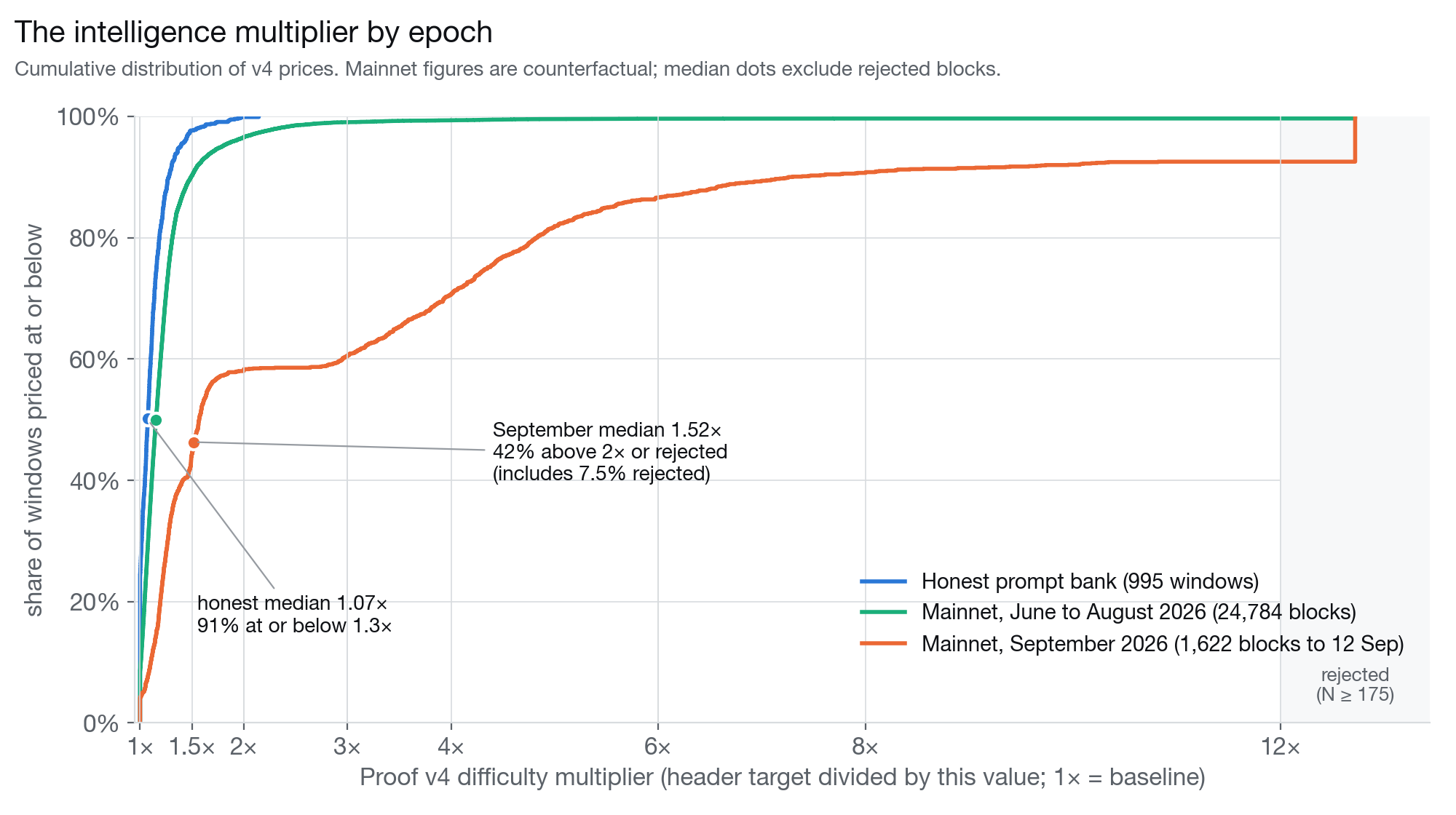
The honest bank stays close to the baseline. Its median multiplier is about 1.07×, and 91% of windows fall at or below 1.3×. The maximum is 2.15×, with no additional rejections under the v4 rule. For the bank’s measured mix of windows, the estimated increase in header work is about 10%, before any network difficulty adjustment.
The mainnet populations differ substantially by epoch:
| Population | Median multiplier | Above 2× or rejected | Rejected |
|---|---|---|---|
| June–August: 24,784 blocks | 1.15× | 3.4% | 0.3% |
| September through the 12th: 1,622 blocks | 1.52× | 42% | 7.5% |
Medians exclude rejected blocks. Rejections are included in the “above 2× or rejected” column.
These results show a modest cost for the tasks represented in the bank and a substantially larger effect on the September mainnet population.
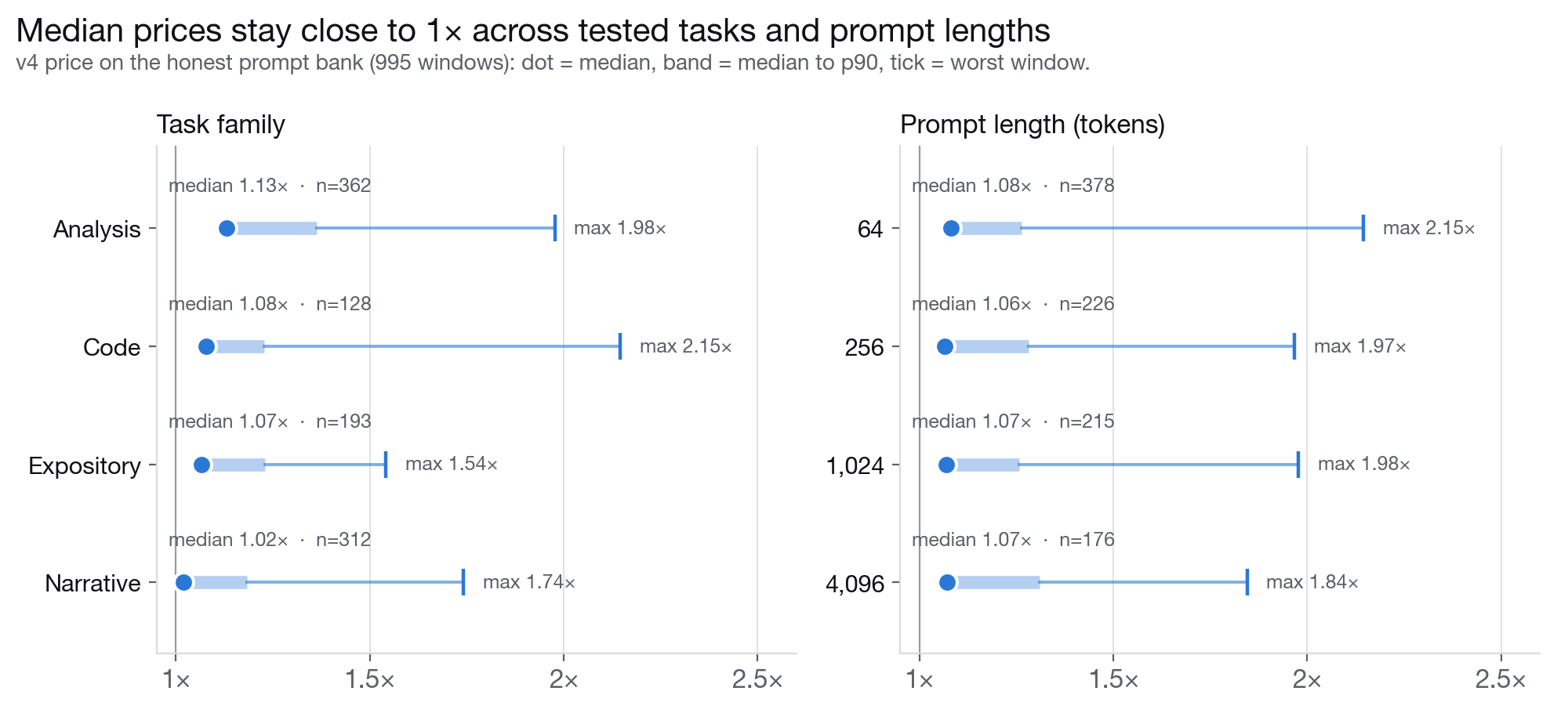
Across the tested task families and prompt lengths, median prices remain close to 1×. Analysis has the highest task-family median, at 1.13×. In this sample, analysis windows tend to accumulate more of their credit later in generation.
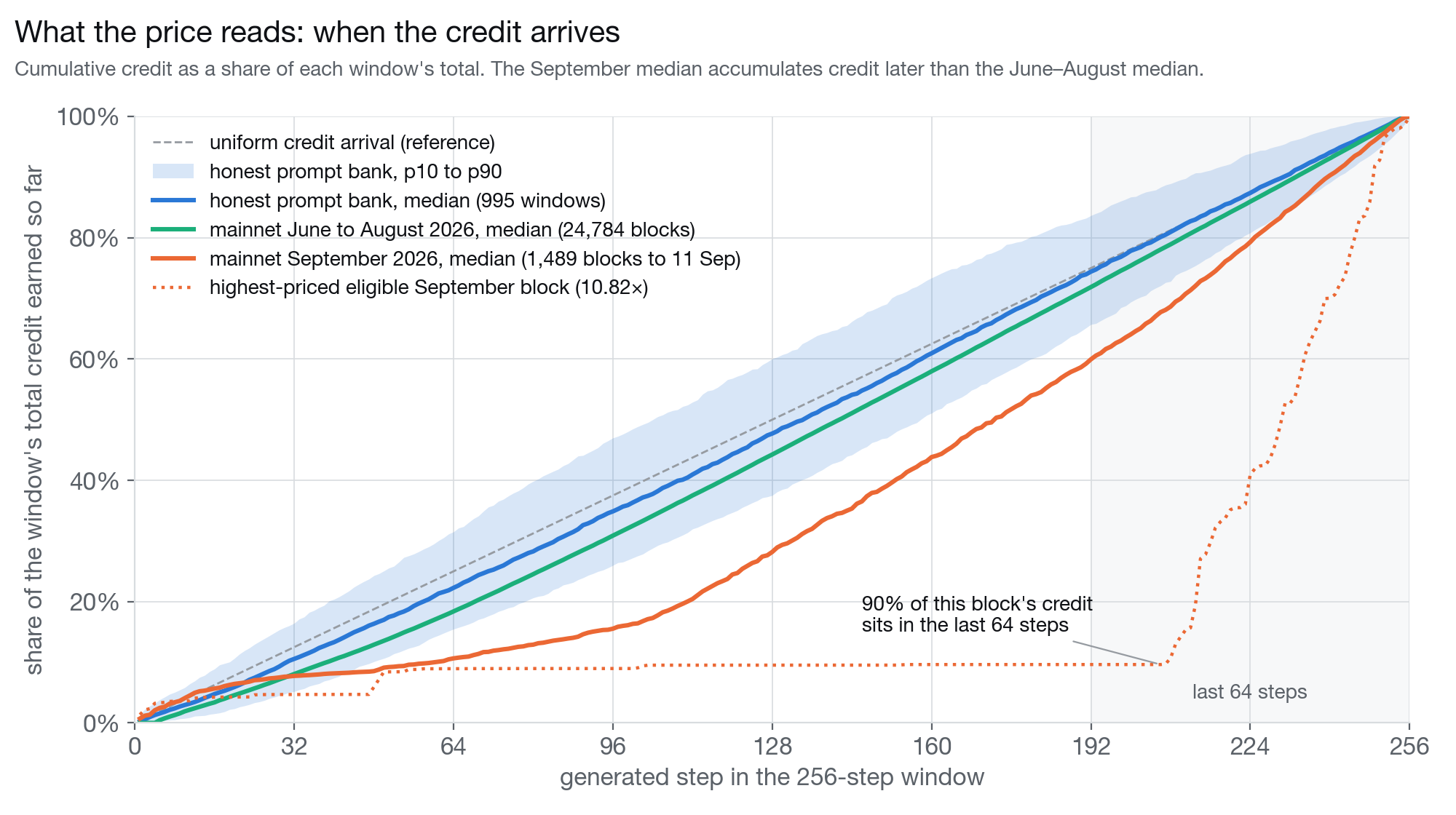
The credit-arrival curves help explain the difference between epochs.
The honest bank and June–August mainnet population accumulate credit relatively steadily. By step 192, the June–August median curve has reached about 72% of its total credit. The September median has reached about 60%.
The highest-priced September block that would remain eligible concentrates 90% of its credit in the final 64 steps.
For this chart, September covers 1,489 blocks through 11 September, reflecting the earlier cutoff of the credit-vector dataset. The pricing results above cover 1,622 September blocks through 12 September.
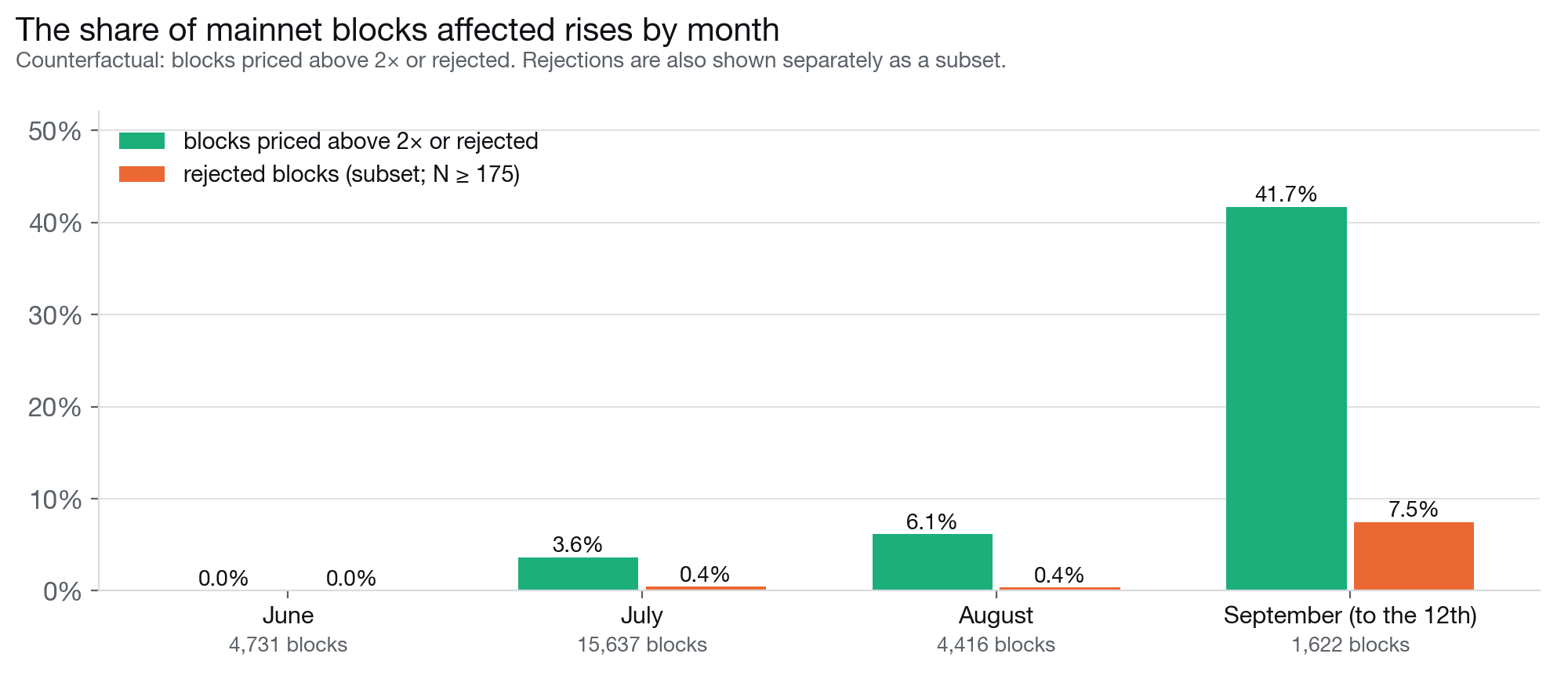
The monthly view shows the scale of the change. In June, only one of 4,731 blocks would have exceeded 2×, and none would have been rejected. By September, 42% would have exceeded 2× or been rejected.
That is the distinction the multiplier is designed to make: generation profiles with delayed or concentrated credit carry a higher cost.
The planned rollout has three activation heights:
- Upgrade. Nodes and verifiers upgrade, and v4 proofs become valid alongside v3.
- Pricing. The intelligence multiplier applies to both v3 and v4 proofs. A one-off reduction in baseline difficulty helps offset the increase in expected work.
- Sunset. V3 proofs are no longer accepted.
Alongside the intelligence multiplier, proof v4 includes:
- Gumbel-race sampling. Each step selects a token through a single race using reproducible noise.
- Argon-bound sampling and result hashing. Every sampling draw and the final hash are tied to a memory-hard output, strengthening resistance to grinding.
- Prompt and continuation reuse checks. The protocol checks for repeated prompts and reuse of protected continuation segments.
- Stricter verification. Updated checks validate the sampling process and apply the rules for the block’s activation stage.
A future proof v5 would explore latency and context. Both are harder problems to address on a UTXO chain, and remain areas for further research.
Authored pseudonymously by Imosuke Takakuni.