
Every proof-of-work subsidy reduction is two things at once: a line of integer arithmetic and a small collective panic.
The arithmetic first. Block 22,164 is the last TensorCash block with a
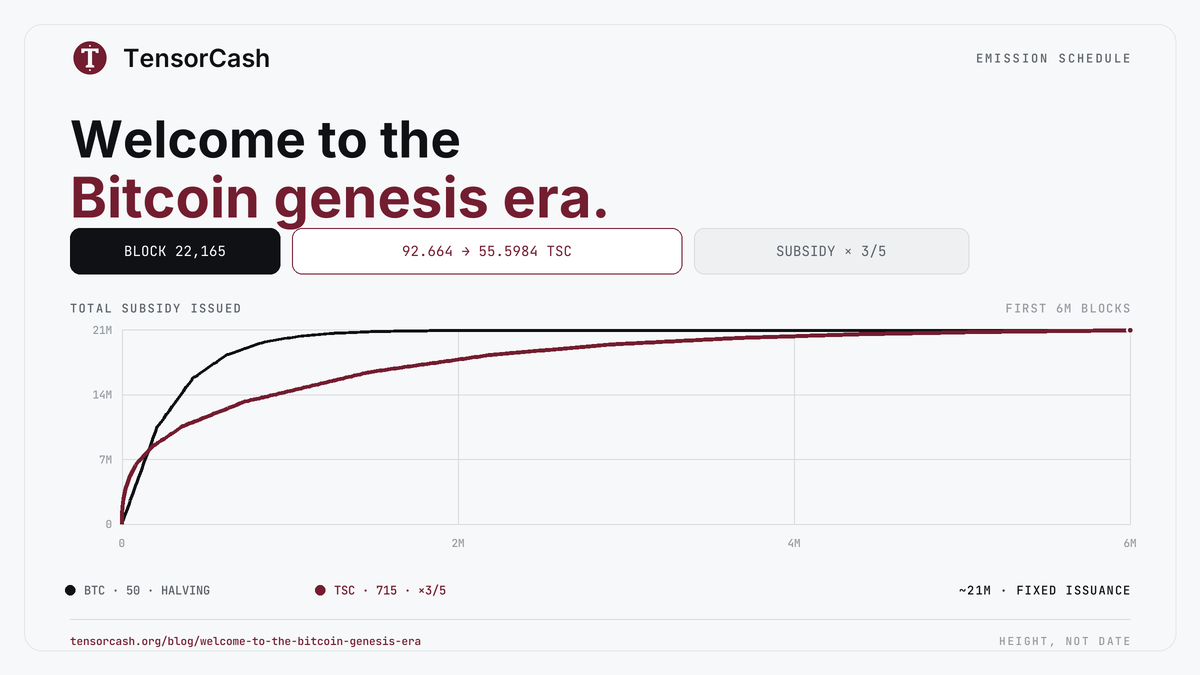
92.664 TSC subsidy. Block 22,165 is the first with a 55.5984 TSC subsidy. The
new figure is exactly the old one multiplied by 3/5: a 40% reduction. Fees,
where present, are additional.
At the time of writing, the mainnet explorer was at block 22,037, leaving 128 blocks. At the ten-minute target cadence, that points to roughly 14 August 2026 at 11:30 UTC. Blocks are probabilistic and the network can run faster or slower, so the date is only an estimate. The height is consensus.
Now the panic.
Welcome to the Bitcoin genesis era
From block 22,165, TensorCash will issue 55.5984 TSC per block. That is not 50, but it is close to one of the most consequential numbers in proof-of-work: Bitcoin launched with a subsidy of 50 BTC per block and kept it for its first 210,000 blocks, from January 2009 until November 2012.
Fifty was Bitcoin’s subsidy, not its difficulty. It defined Bitcoin’s first subsidy era — its genesis era.
So: welcome to the Bitcoin genesis era.
This is not a claim that one TSC is equivalent to one BTC. It is a comparison of issuance pace. After the reduction, TensorCash will still create coins per block at roughly the rate Bitcoin did when its network, market and culture were all being invented. In that limited but useful sense, this is still a remarkably early time to join.
Proof-of-work circles have a durable fear of being “late.” The previous epoch always looks easier and more remunerative because, by design, it was. Earlier miners accepted earlier software, a smaller network, less mature tooling and an unproven market for verifiable inference. The higher subsidy paid for that operational risk.
But “earlier” and “late” are not the only choices. Bitcoin’s 50 BTC era was not the afterparty. It was the beginning.
Why reduce the subsidy at all?
The coinbase transaction is special: it creates the block subsidy according to rules every full node checks. If that subsidy stayed constant forever, supply would grow forever too.
A declining schedule does three jobs:
- it makes new issuance predictable rather than discretionary;
- it lets anyone calculate the eventual supply from the consensus rules; and
- it makes each successive unit scarcer relative to a constant-reward system.
Scarcity does not guarantee price or value. It does prevent value from being diluted by unlimited protocol issuance. TensorCash’s implemented integer recurrence ends at 21,184,153.03530240 TSC — about 21 million — with no committee able to improvise another mint.
That ~21 million destination is the part of Bitcoin’s design we most wanted to keep.
Keep the destination; change the road
Bitcoin is the great comparison because it established the fixed-supply proof-of-work currency. TensorCash deviates where its own engineering problem is different.
Bitcoin did not need to prove that thousands of GPUs could run useful model inference at the same time and have their work measured fairly. TensorCash does. Its early risk was not defining decentralised currency from scratch. It was bootstrapping a decentralised inference network: miners, models, verifiers, nodes and the software connecting them.
That led to two changes in the release curve.
1. Epochs start short and get longer
The first TensorCash epoch lasted 715 blocks. Each following epoch doubles in length until the duration reaches a cap of 732,160 blocks.
Short early epochs let the release curve acknowledge early operational risk. The network changes quickly when a handful of people are discovering what works. Later, when the network is mature and industrial operators are planning GPU capacity, datacentre contracts and model deployments, longer epochs provide a more stable planning horizon.
The new 55.5984 TSC epoch lasts 22,880 blocks, from block 22,165 through 45,044. At target cadence, that is almost 159 days — already twice as long as the epoch now ending.
2. The subsidy keeps three-fifths, not one-half
At every epoch boundary, TensorCash multiplies the subsidy by 3/5. In other
words, it retains 60% and removes 40%. Bitcoin retains 50% at each halving.
The softer step avoids repeatedly dropping rewards off a 50% cliff. Combined with the longer later epochs, it also stretches the subsidy tail much farther into the future: under the exact eight-decimal consensus arithmetic, TensorCash has 48 non-zero subsidy epochs before the subsidy reaches zero.
The destination remains finite. The road gives the network more time to mature before fees must carry it alone.
Supply over blocks
Total subsidy issued
Exact integer subsidy rules from Core: Bitcoin halvings against the TensorCash epoch-decay schedule, shown through the first 6,000,000 blocks.
- Horizon
- ...
- BTC @ 6M
- ...
- TSC @ 6M
- ...
Why put more coins into circulation early?
A currency cannot discover much while it sits still.
Higher early subsidies move more of the eventual supply into circulation while the network is forming. Miners receive coins for supplying verified inference; coins can then move peer to peer to people who want to hold, spend or use them. Those exchanges create actual price discovery between participants, rather than a price declared by the protocol or an official sale.
That is the bootstrap logic: reward the people taking the earliest operational risk, circulate enough supply for a market to form, then make new issuance steadier and scarcer as the network matures.
The block-height version
| Rule | Height / amount |
|---|---|
| Last block in the current epoch | 22,164 |
| First block in the new epoch | 22,165 |
| Current subsidy | 92.664 TSC |
| New subsidy | 55.5984 TSC |
| Change | × 3/5 (−40%) |
| New epoch ends | 45,044 |
| Exact terminal issuance | 21,184,153.03530240 TSC |
You can inspect the complete curve on the mission page, read the rationale in the Core Node paper, and inspect the consensus implementation.
At block 22,165, the arithmetic changes. The mission does not: make useful AI work verifiable, let open participation coordinate the machines, and keep the money finite.
Welcome to the Bitcoin genesis era.
This article explains a consensus schedule. It is not a price forecast or investment advice. The timing estimate uses the mainnet tip observed at 14:13:42 UTC on 13 August 2026; block 22,165, not a date, activates the new subsidy.
Authored pseudonymously by Imosuke Takakuni.